

Beginning in 2003, Chad hosted approximately 400,000 refugees, mainly along the eastern border, who fled Sudan when violence erupted in Darfur. In April 2022, the humanitarian needs in these camps have significantly increased due to the resurgence of violence and crisis in Sudan. These events brought an additional 400,000 new refugees in September 2022. With these events and the influx of child refugees, child marriage has become more prominent as families attempt to reconcile their current situations. In addition, the increase in refugees has made it significantly more difficult to disperse sexual reproductive health services to adolescent children. As a result, the current state of child marriages has become a global crisis for young girls.
Child marriage among girls is most prominent in South Africa and sub-Saharan Africa, with 10 countries having the highest amounts of child brides. Niger leads the world in the most significant amount of child brides, with 77% of girls under 18 being married, and 30 percent of those under 15. Bangladesh has the most child brides under 15, and India by itself has one-third of the world’s total. Overwhelmingly, child brides come from the most impoverished nations. Some boys are also married young; however, girls are disproportionately affected. For instance, in the Republic of Moldova, only 2% of men were married before age 18. In total worldwide, 700 million women alive were married before they were legally eighteen. The continuation of child brides comes from poverty, social norms, religious beliefs, preserving family honor, or providing “protection” for their family’s future. Girls at most risk are often the ones whose family lacks a standard income, leading to 2.5 times more likely.
In all regions, girls from less-developed rural areas face a larger likelihood of becoming child brides earlier than their counterparts who live in urban areas. This seems to be the case because underage marriage is significant when families try to alleviate their economic situation, as it gives the families one less mouth to feed. In areas where the girl’s family pays a dowry, compensation for the bride’s future in their existing family, marriage at a younger age can mean a less expensive dowry. However, in other communities, the roles are reversed, and the man pays the bride’s parents a dowry. The younger the girl, the higher the price, because that means the wife has more time to spend raising kids and doing housework. Young girls are often married to offset debts, bring in money, and settle social conflicts. As illustrated, child marriage infiltrates multiple economic incentives that make it appealing for parents to marry off their young girls. Also, the practice has a cycle of entrapping girls and their future children into a lifetime of economic disadvantages. Even though poverty is a root cause of child marriage, it is also a repercussion of child marriage.
Along with an inability to reach resources to protect against underage marriages, adolescent-responsive sexual and reproductive health (SRH) services remain largely unmet globally. Currently, pregnancy complications, such as infections, unsafe abortions, and eclampsia, are the leading causes of death for adolescent girls aged 15-19 in low-income countries. An estimated 32 million adolescent girls in low-income countries want to avoid pregnancy, but 43% of them do not have access to modern contraceptives. However, adolescent maternal deaths in low-income countries would drop by an estimated 63% if adolescents’ contraceptive needs were met and pregnant adolescents received supportive care.
Attitudes toward sexual and reproductive health services create barriers for girls who are pregnant or engaging in premarital sex. These beliefs about reproductive health greatly influence how girls view available resources. Family members and healthcare providers also reinforce this stigma through their behaviors, such as fostering societal shame and withholding accurate information about specific practices. As a result, healthcare providers could propagate their own biases and fears of parental reprisal, contributing to girls feeling disrespected or judged when seeking services. Data on sexual reproductive health resources for adolescents living in humanitarian camps are limited, and many experts agree that negative connotations and vulnerability to adverse outcomes are magnified in these environments. “Girls our age should be thinking about schoolwork and their future, not being forced into marriage; it’s honestly really hard to imagine that being the reality for so many young girls,” said Concannon ‘26. Due to crises, many girls’ support systems are disrupted and force them to take on additional responsibilities that expose them to violence, exploitation, and unintended pregnancies. One of the most common coping mechanisms, unsafe abortions, can have dire and lifelong impacts on adolescent health.
Though there are some global standards for providing adolescent-responsive sexual reproductive healthcare, there is a current lack of diverse and nuanced knowledge on the attitudes and behaviors of affected adolescents. Without proper insight into adolescents’ health experiences, humanitarian actors will misdirect their efforts and struggle to fulfill their obligations of providing services. Therefore, it is essential to disseminate learning about adolescent experiences in settings such as eastern Chad.
With the increase in refugees in eastern Chad camps due to the violence in Darmar, the International Rescue Committee (IRC), the Ministry of Health and the Association Tchadienne pour le Bien-Etre Familial (ASTBEF) implemented the Protection, Gender and Health (ProGeSan) program in two provinces in Chad, including in the Mile and Kounoungou refugee camps, between 2021 and 2024. ProGeSan’s mission is to enhance the social empowerment of women through improved access to SRH services and gender-based violence support systems for all women and girls, from newborn to elder. Additionally, other healthcare centers, such as the IRC, have provided trained youth peer educators (school-based) and youth facilitators (out-of-school) who provide SRHR education and information to adolescents in the camps. Outside of education, the IRC designed a program called Girl Shine, which offers adolescents in humanitarian settings with local mentors and facilitates support and empowerment activities for a cohort of girls. In 2022, IRC, the University of N’Djaména and the RAISE Initiative at Columbia University’s Mailman School of Public Health conducted a mixed-methods study in the Mile and Kounoungou refugee camps to examine adolescent refugees’ SRHR knowledge, attitudes and behaviors, and to identify barriers to SRH service utilization. This study was a representative quantitative study of teenage girls aged 12-19 years. A list of adolescents was stratified by age group (12–14 years, 15–17 years, 18–19 years) and extracted from household lists maintained by UNHCR. For each camp, 150 girls were randomly selected from each age group.

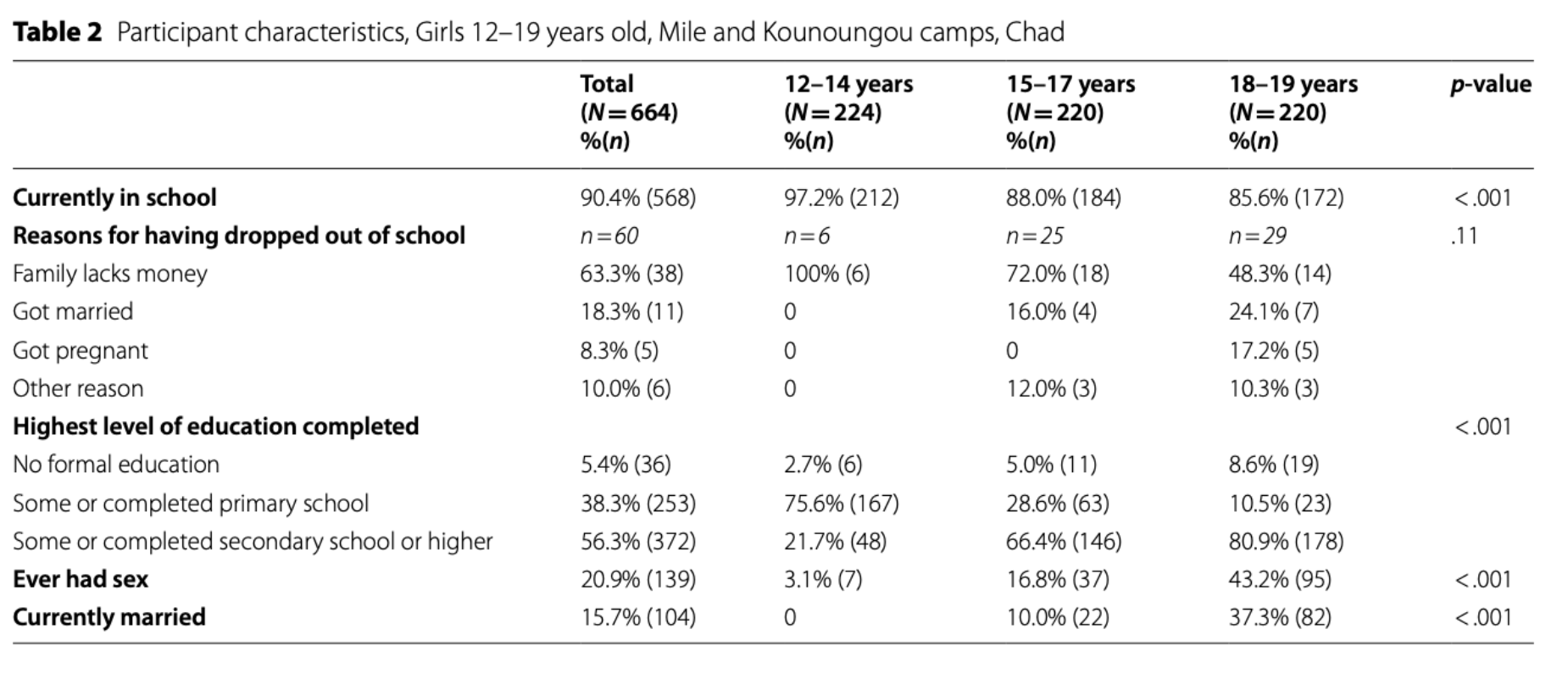
The vast majority of girls (87.5%) in the survey had lived in the camp for 10 years or more, and all were Muslim. Nearly all girls were in school at the time of the study; however, more girls aged 12–14 (97.2%) were enrolled compared to those aged 18–19 (85.6%). Among girls who were not in school, the most common reasons for dropping out were their family’s lack of financial resources (63.3%) or early marriage (18.3%). Older girls were also more likely to be married: 10% of girls aged 15–17 and 37.3%. Of girls aged 18–19, compared to none of the 12–14-year-olds. During the participatory research activities, most girls described marriage before age 18 as ‘forced’ and an adverse event in a girl’s life. In contrast, marriage at 18 years or later was identified as a positive event. Analyzing this data, it becomes apparent that economic hardships and societal struggles provide girls with an unfair burden to resolve these issues, disrupting their actual goals.
The research also concluded that all four groups of adolescent girls participating in the study identified education as one of their top three priorities. Many girls of various age groups highlighted that marriage and pregnancy often disrupted their education. They reported that husbands or parents compelled them to leave school after marriage, or that childcare responsibilities made attending school impossible. “What stood out to me was how the girls are forced to leave school early; it really shows the privilege of our education since it isn’t equal everywhere,” Lai’26 said. Girls said that parents usually decided on marriage, sometimes without involving the girl, especially in cases of early or forced marriages. They described various motivations for parents, including the potential husband’s ability to provide a good life for the girl or to prevent her from becoming pregnant before marriage. The girls’ understanding of their situation also reveals a shared view among them due to similar personal experiences, proving that these cases are deeply rooted in societal pressures.
Along with implementing systems of education, it is also essential to have a policy-centered approach, because most social norms are based on systematic structures that position adolescent girls to continue to be preyed on as wives. In Nigeria, the Federal Ministry of Women Affairs (FMWA) plays a central role in policy development, including the National Strategy to End Child Marriage (2016–2021), which focuses on education, legal reform, health services and advocacy. Additionally, the ministry has led numerous campaigns, one of which was the domestication of the Child Rights Act across Nigeria’s states, with support from UN Women and UNICEF. Other organizations, such as Girls Not Brides and Equality Now, also collaborate with law enforcement, civil society and lawmakers to prioritize and implement legal standards. These legal frameworks, such as Nigeria’s Child Rights Act (CRA), provide formal structures that prohibit child marriage, and various international and domestic organizations facilitate their implementation. Plan International, Girls Not Brides and FIDA Nigeria support the enforcement of these legal frameworks through advocating for legislation reform with local agencies, like the Federal Ministry of Women Affairs. However, these efforts are still resisted due to political, cultural and religious beliefs. The disconnect between the localized application of these laws and the societies in which they are implemented reveals a power dynamic in which international treaties do not automatically guarantee protection. Overall, the effectiveness of these legal frameworks depends on the legitimacy and strategy of the alliances between the organizations tasked with enforcement and implementation. These difficulties and tensions highlight the deeper structural challenges and tensions that hinder the legal eradication of child marriage.
Overall, a combination of strengthening adolescent girls’ sexual reproductive health education and legal frameworks provides a vital insight into the possibility of minimizing or eradicating Child Brides in Chad’s humanitarian settings.


