

Climate change is often discussed in terms of rising temperatures, stronger storms and damaged ecosystems. In Bangladesh, however, its effects are much more personal. For many families, climate change is forcing them to leave their homes and move to already crowded cities in search of safety, work and stability.
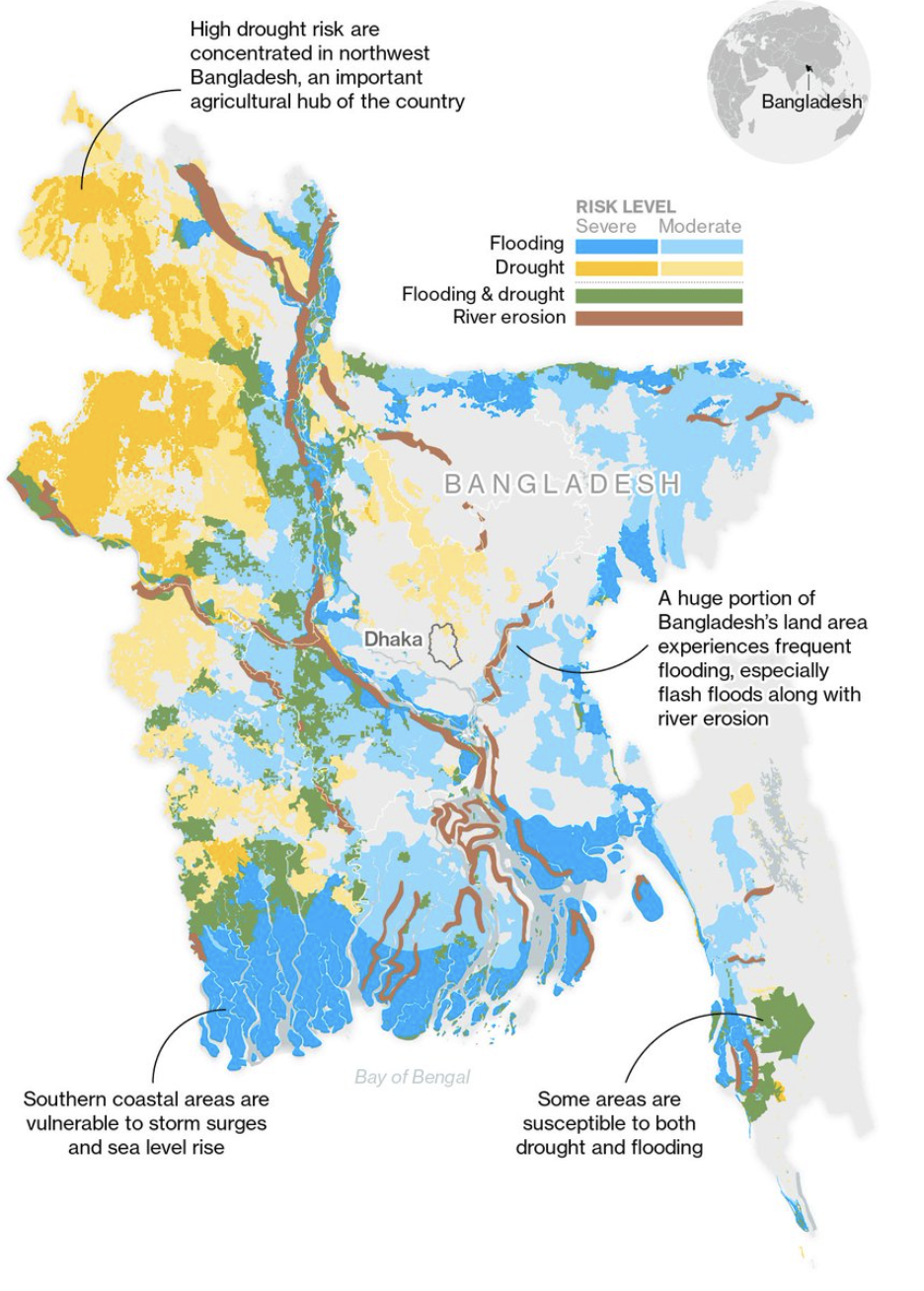
Bangladesh is one of the most climate-vulnerable countries in the world due to its location in a low-lying delta. Floods, cyclones, river erosion and saltwater intrusion regularly damage homes, farms and roads. For people who depend on agriculture and fishing, these disasters can destroy their ability to earn a living. As a result, many families leave rural areas and migrate to cities such as Dhaka, hoping to rebuild their lives.
But urban migration has created a new problem. Cities are not prepared to support such large numbers of new residents. In Dhaka, where population growth has exploded in recent decades, many migrants end up in informal settlements with limited access to clean water, sanitation, health care and stable housing. Instead of escaping danger, many families simply move from one kind of hardship to another.
“Climate migration is easy to talk about as a statistic, but it really means families losing everything they know,” Catherine Zhang ’26 said.

The scale of the crisis makes it clear why Bangladesh is so vulnerable. The country sits on a wide river delta and faces repeated environmental pressure from both sudden disasters and long-term climate changes. In coastal and riverbank regions, flooding can wipe out crops within hours. Cyclones can destroy homes and infrastructure in a single day. River erosion can slowly erase land that families have depended on for generations. Saltwater intrusion can make farmland unusable and contaminate drinking water. All of these pressures make it harder for rural families to stay where they are.
For many households, migration becomes less of a choice and more of a necessary survival strategy. A family may first try to stay after a flood or a storm, but repeated disasters can make recovery impossible. When crops fail and income disappears, parents often decide that moving to a city is their only option. They hope to find jobs, safer shelter and better opportunities for their children. Instead, they often arrive in places already overwhelmed by poverty and overcrowding.
Dhaka is the clearest example of this pressure. Once a much smaller city, it has grown into one of the largest urban centers in the world, and that growth has not happened in a controlled way. Much of it has been driven by migration from rural areas due to climate change. As more people arrive, the city’s infrastructure struggles to keep up. Roads, drainage systems, sanitation networks, schools and hospitals all face increasing strain. Housing is especially limited, which forces many migrants into slums or temporary shelters.
These settlements are often built in unsafe places, including flood-prone land or areas exposed to pollution. Many families live in overcrowded rooms with little privacy and even less stability. Access to safe water and sanitation is often inconsistent. In a place where disease can spread quickly, poor living conditions become a serious health risk. Children, older adults and pregnant women are especially vulnerable.
“People tend to think of climate change as something that happens far away, but it affects real people every day,” Kiran Dhaliwal ’26 said. “It is important for us to understand that because these issues could affect us in the future.”
The crisis is not only about physical displacement but also about social exclusion. Many climate migrants are treated as outsiders in their new communities. Without legal recognition or enough political voice, they are often left out of city planning and public services. Some are labeled as unwanted or temporary residents even when they have lived in the city for years. This makes it harder for them to improve their lives or access support.
Women face even more challenges. Female migrants often have fewer job opportunities and greater exposure to harassment and violence. They may also carry the burden of childcare while trying to earn income in unstable jobs. In addition, they often have less access to health care and fewer protections in the workplace. That means climate migration is not just an environmental issue. It is also a gender issue and a human rights issue.
The situation in Bangladesh shows that climate change is not caused by one problem alone, and it cannot be solved by one solution alone. Environmental damage pushes people out of rural areas, but poverty in the cities grows because of weak planning, limited resources and a lack of legal protection. In other words, climate change starts the crisis, but poor systems can make it worse. That is what makes the problem so urgent.
That is why the answer has to be both practical and fair. Bangladesh cannot solve climate migration by focusing only on rural areas or only on cities. Rural communities need stronger protection from floods, erosion and salinity so fewer families are forced to leave in the first place. At the same time, cities need better planning that assumes migration will continue and treats migrants as part of urban life instead of as a temporary burden.
A more sustainable response would include legal recognition for climate migrants, better access to housing and services and stronger support for low-income neighborhoods. Slum upgrading, clean water systems, sanitation and safer housing can reduce suffering in the short term. Over time, cities need more affordable housing, better transportation and job programs that help migrants enter the urban economy in more stable ways. If people are already moving to cities, then those cities have a responsibility to provide conditions where they can live safely and with dignity.
Community participation is also important. Solutions work better when migrants are included in the decisions that affect their lives. People living in informal settlements understand their own challenges better than distant policymakers do. Their experiences should help shape housing plans and disaster preparation.
Bangladesh has already taken some steps in the right direction. National strategies and disaster plans now acknowledge the need to address displacement and urban issues. Nongovernmental organizations have also created programs that improve housing, livelihoods and local support in low income neighborhoods. These efforts matter because they show that change is possible, but they are still limited in scale when compared with the size of the crisis. Without stronger funding and clearer policies, the pressure on cities will continue to grow.
The larger lesson from Bangladesh is important for the rest of the world. Climate migration is often discussed as if it belongs to the future, but in places like Bangladesh, it is already happening. People are moving because climate change is making some places harder or impossible to live in. When they arrive somewhere else, they enter systems that may already be unequal, underfunded and overcrowded. That is why climate migration is also a social justice issue.
For Berkeley students, this issue matters because it shows how global problems connect to values that matter in our own community. Learning about climate migration encourages students to think about empathy, leadership and responsibility. It also reminds us that climate change is not just about the environment, but also about people and the choices societies make when faced with difficulties. As a school community, Berkeley can use conversations like this to better understand the world and the role young people can play in shaping it.
This crisis also challenges the way we think about adaptation. Adaptation is not only about building stronger walls or repairing roads. It is also about protecting people’s rights, improving access to services and creating cities that can handle change without abandoning vulnerable communities. If climate migration is treated only as a burden, it will worsen poverty and exclusion. If it is treated as a reality that requires planning and compassion, it can be improved upon in the future.
Bangladesh’s urban future will depend on whether leaders respond to migration with short-term reactions or long-term plans. Every flood, cyclone and eroding riverbank pushes more people toward the cities. Every overcrowded neighborhood, unsafe building and broken service system shows what happens when those arrivals are not planned for. Climate change is changing Bangladesh completely, and its cities are now where that crisis is most visible.
The question is no longer whether climate migration will happen. It is whether Bangladesh’s cities will be ready to face it, and whether we will be ready to face in the coming decades.


